What are Lenormand Houses
A House is a life domain. It describes the context — the area where something plays out. The card describes what manifests there: what happens, what acts, what blocks, or what opens.
House and card are not the same. The House sets the stage. The card writes the scene.
Why Houses are essential in interpretation
Cards alone tell a lot, but not always where this plays out in real life. Two readings with the same cards can tell two different stories if cards land in different Houses.
Houses bring precision, coherence, and emotional clarity. They place each message in a concrete life area and prevent vague or fear-based readings.
How Houses work in the Grand Tableau
The 36 Houses and their order
Houses follow the canonical order of the 36 Lenormand cards: Rider first, Clover second, and so on until Cross.
A card always falls in a House
Even when you don’t read Houses consciously, they are active. A card is always somewhere, and that location deeply changes interpretation.
House and card: the core rule
The House indicates the domain. The card describes what manifests there.
The card does not change its nature. The House changes its tone, expression field, and impact zone.
How a card is tinted by the House
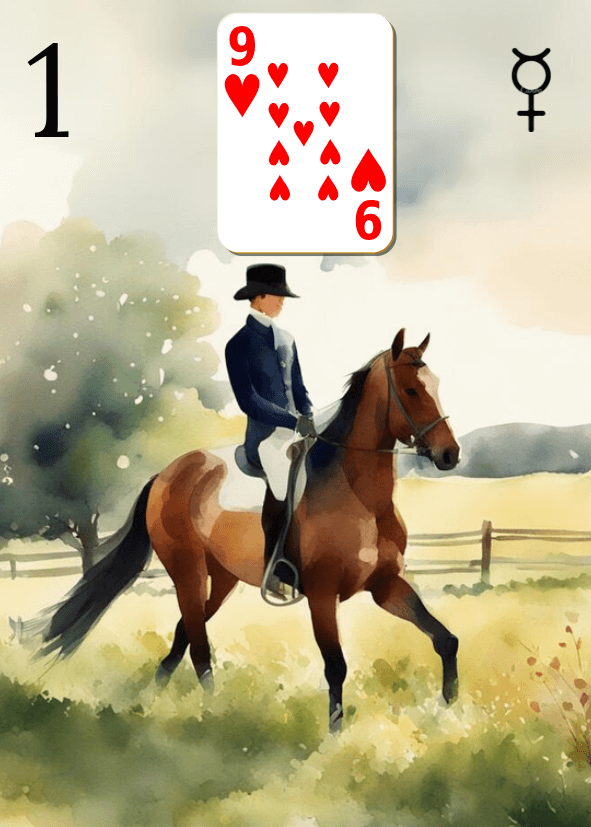
Imagine Rider falling in a relationship House. It does not describe generic change, but relational movement: communication starts, a message arrives, initiative enters the bond.
The same Rider in a career House no longer tells a love story. It points to a project launching, a work-related trip, or an opportunity moving forward professionally.
The card stays the same. The House changes the setting and the way the message takes form in real life.
What House-based reading reveals
Reading through Houses reveals life priorities, sensitive areas, protected domains, and where flow is natural or blocked. It is a more strategic and soothing way to read.
Do you need to memorize all Houses?
No. Logic matters more than memorization. Understanding structure is worth more than learning lists by heart.
Beginners and advanced readers
When you begin
One card, one House, one life domain. Set the context first, then read the card inside it.
When you master Grand Tableau
Then you add interactions, axes, positions, and significators. Houses become a mental map of life domains, while cards become a precise language.
Grand Tableau House board
Click a House to open its panel and explore its domain.
List of the 36 Lenormand Houses
Each House is linked to one card, one domain, and one characteristic tone.
Most common mistakes
- Confusing House and card. The House is the domain; the card is what happens in it.
- Overinterpreting. A House gives precision; it should not create drama.
- Looking for prediction instead of context. A House tells where to look. Outcome emerges from the full tableau.
Houses do not make reading harder. They make it clearer.